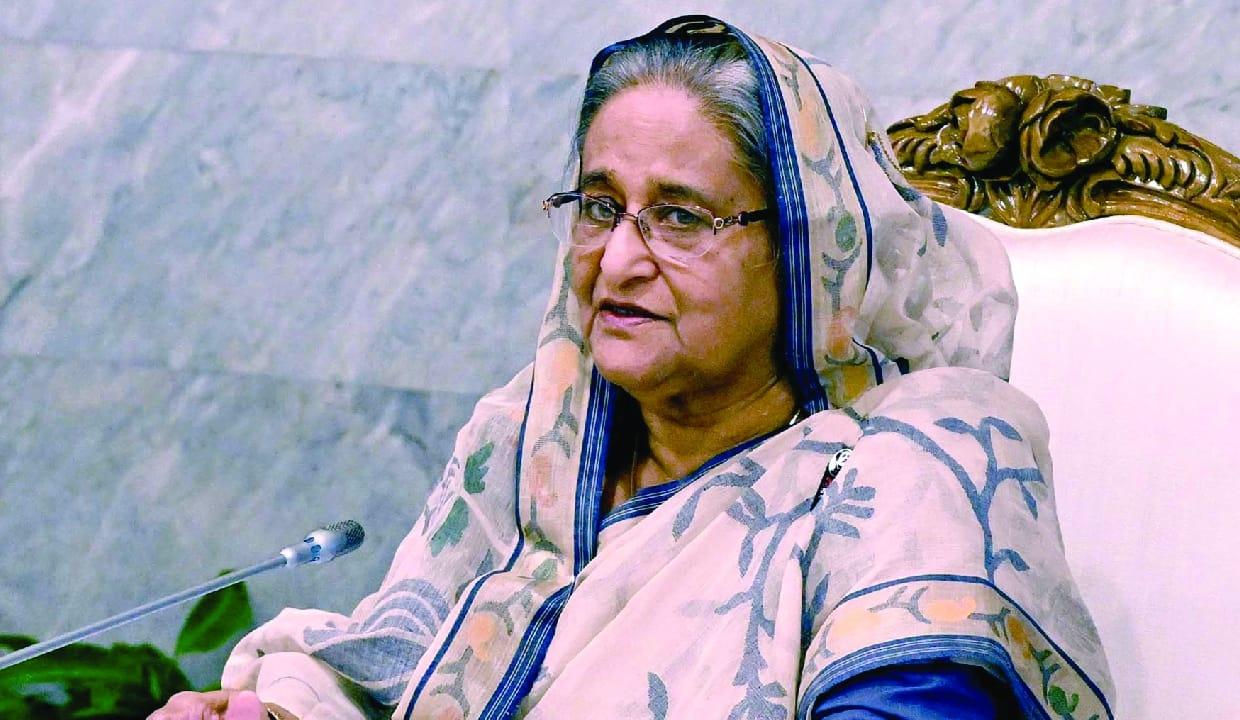
My Decision to Return to Bangladesh Is Not About Power; It Is About Putting the Country Back on the Right Track and Restoring Stability
My people are suffering, and I must stand beside them. At such a time, standing beside them is not a choice — it is my responsibility.
My decision to return to Bangladesh is not about personal desire or political ambition. It is about duty. My people are suffering, and I must stand beside them. Bangladesh is in deep distress today, and people are carrying that burden in their daily lives. Their lives are insecure. The rule of law has collapsed. Freedom of expression has been taken away. Women and children face abuse and violence every day. Minority communities are living in fear. Terrorism and religious extremism are once again finding space, threatening the secular and peaceful character of Bangladesh. Ordinary families are being crushed by rising prices. Young people are unemployed and losing hope. Farmers, workers, day labourers and hardworking people are living through unbearable hardship. These people are calling me. They believe I can help rescue Bangladesh from this painful situation. At such a time, standing beside them is not a choice. It is my responsibility.
After August 2024, when Muhammad Yunus seized power, Bangladesh's economic condition deteriorated sharply. During the Awami League period, poverty had fallen to 18.7 percent. Under Yunus, it has reportedly risen to 46.8 percent, according to World Bank findings. GDP growth was 7.25 percent in 2023, and our average growth was around 6.80 percent. By 2026, it had fallen to only 2.22 percent. Per capita income had reached 2,793 dollars by June 2024, but after the change of power in August, the dollar became more expensive and people's real income started falling.
Industrial production growth is now only 4.60 percent, one of the lowest levels in Bangladesh's 54-year history. Defaulted loans in the banking sector were around 13 percent during the Awami League period. Under the Yunus-Tarique arrangement, defaulted loans have reportedly risen to 47 percent. Domestic and foreign investment has almost stopped. Job opportunities for young people have collapsed. Around two crore people have newly become unemployed. During the Awami League government, five crore people moved from the lower-income group into the middle class. Now nearly six crore people have been pushed back into hardship.
Even the Finance Minister of the BNP government has admitted that the government is running by borrowing 700 crore taka from banks every day. More than 500 industrial factories have closed. Many factories have been burned or destroyed, leaving workers unemployed. Five fertilizer factories have stopped production, creating pressure on agriculture. The prices of fertilizer, seeds and other agricultural inputs have increased, but farmers are not receiving fair prices for their produce. Nearly half of business owners are either in prison, trapped in false cases, or forced to leave the country. Bangladesh was the second-largest garment exporter in the world, but now hundreds of garment factories are closing and both women and men workers are losing their jobs. Projects taken during the Awami League period have seen costs increased by 50 percent to 250 percent. In only two years, Bangladesh's financial condition has been pushed into a deeply alarming state.
I want to add one point because I am speaking to Bloomberg. When my government purchased essential commodities from the international market, I used to ensure that international market prices were checked, including through Bloomberg data, before allowing letters of credit to be opened. That was part of our discipline in protecting public money, preventing overpricing and safeguarding Bangladesh's foreign exchange.
The death sentence against me is not justice. It is part of an illegal, unconstitutional and politically motivated process. No accepted standard of fair trial was followed in this kangaroo trial. I was not given a real opportunity to defend myself. False allegations were dressed up through staged testimony and fabricated evidence, and a judicial process was turned into a political spectacle.
And this is not only about one verdict. More than 600 false cases have been filed against me. The purpose is clear: to remove me from politics and separate me from the people of Bangladesh. But let me say this plainly. A death sentence, false cases and staged trials cannot frighten me. I have lost almost my entire family, including my father, mother and brothers. There have been 19 attempts to assassinate me. Personally, I have nothing left to lose. I have dedicated my life to the people of Bangladesh. I will return to them.
The ban on the Awami League is, in reality, a ban on democracy in Bangladesh. The same conspiratorial forces that created 5 August and are now pushing the country towards destruction imposed this ban so they could carry out their anti-Bangladesh agenda without resistance. They know that if the Awami League remains in the political field, their conspiracy cannot succeed. They knew that if the Awami League had been allowed to contest the election, it would have won decisively. Independent surveys, even surveys by state intelligence agencies, showed that if the Awami League had participated in the 2026 election, 63 percent of the people would have voted for us. That is why the Awami League was kept out of the election through an unlawful ban. They did not defeat the Awami League at the ballot box. They removed it before the people could speak.
This ban cannot be seen only as a party issue. The Awami League is inseparable from the spirit of the Liberation War and from the welfare of Bangladesh. Under the leadership of the Father of the Nation, Bangabandhu Sheikh Mujibur Rahman, the Awami League led the struggle that secured Bangladesh's independence. Every major achievement of this country has come through the Awami League.
After 2008, during 16 years in government across four consecutive terms, we maintained GDP growth between 6.5 percent and 7.5 percent. We raised the economy from 70 billion dollars to 450 billion dollars. Per capita income increased from 482 dollars to 2,784 dollars, the highest in South Asia. We brought poverty down from 41 percent to 18.7 percent and extreme poverty from 25.1 percent to 5.6 percent. We brought electricity to every citizen. We raised power generation capacity from 3,782 megawatts to 28,563 megawatts. We introduced 145 social safety net programmes and brought nearly ten crore people under different forms of allowance and support. In 2021, Bangladesh achieved developing country status. By 2023, Bangladesh had become the 35th largest economy in the world.
At the same time, we declared zero tolerance against terrorism and militancy and brought them under control. We modernised law enforcement agencies and built a Bangladesh where people could live without fear. The Awami League government did everything possible to improve people's lives. So, banning the Awami League and keeping it away from politics means blocking Bangladesh's development journey, destroying democracy, denying political rights to millions of citizens, and insulting the spirit of the Liberation War.
The quota movement of 2024 cannot be understood if it is treated simply as an ordinary student protest. The events after 5 August proved that quota reform was not the real objective. Behind the demand to abolish quotas, a planned and violent situation was gradually created with one aim: to bring down the government. Extremist groups, BNP Jamaat cadres, opportunist elements and anti-state networks were actively involved in that movement. They participated in it, organised around it and financed it.
In response to student demands, the Awami League government had already abolished the quota system in 2018. Later, in 2024, when the High Court cancelled that decision after a petition by some students, it was my government that appealed against that ruling and sought to keep the quota abolition decision in place. Following that appeal, the Appellate Division stayed the High Court verdict in June 2024. Even after that, a movement began again in July in the name of abolishing quotas.
Still, we wanted dialogue with the students. We informed them that, if necessary, we were prepared in principle to find a permanent solution through legislation in parliament. Our position was clear. We wanted a peaceful solution. But the demands kept changing. Whenever dialogue was offered, new demands were raised. Finally, the movement moved to a one-point demand: my resignation.
The first casualty of the movement took place on 16 July, when Sabuj Ali, a Chhatra League worker of Dhaka College, was killed. On the same day in Chattogram, Chhatra League workers were beaten and thrown from a four-storey building. Rumours were spread that ordinary students were being killed at Dhaka University, although not a single student was killed on the Dhaka University campus in July or August. Across the country, planned attacks began against Awami League leaders and activists. That is how the movement was pushed into violence. When law enforcement agencies came under attack, they were forced to take measures in self-defence.
The video of Abu Sayeed, a student killed at Rangpur University, was circulated widely on social media to inflame public anger. After that, the character of the movement changed very quickly. Metro rail stations, police installations, flyovers, university administrative buildings and public and private property were set on fire. Police personnel were killed. Awami League and Chhatra League workers were brutally attacked. In several places, bodies were hanged or burned in acts of shocking barbarity.
On 18 July, I formed a Judicial Inquiry Commission to establish the truth behind every death, every bullet fired and every act of violence. I also invited the victims' families to Ganabhaban, consoled them personally, and instructed the authorities to ensure swift investigation and justice. The injured were given the highest level of free medical treatment. But after 5 August, the illegal interim regime led by Dr Yunus suspended that Judicial Inquiry Commission. Why did they stop it? If they truly wanted justice, why were they afraid of a judicial inquiry? If they were not responsible, why did they prevent the facts from coming out? They did not stop there. Rather than allow an independent investigation, they granted indemnity and political protection to those involved in atrocities during the July movement. By suspending the inquiry, they closed the path to truth. Justice was not allowed to take its course; the process was buried, and a political narrative was built over the dead.
From the very beginning, I wanted to handle the situation through peace and dialogue. The movement could have been dealt with more strictly because, in the name of protest, the conspirators were trying to destroy the country's law and order system. They attacked 460 police stations. They attacked Enayetpur Police Station and brutally killed 13 police personnel. They even killed ordinary students to make their conspiracy succeed. Even then, I sought a solution through dialogue. I gave specific instructions to ensure the safety of female students and ordinary students. But through false information, propaganda, planned violence and killings, the situation was deliberately pushed towards the fall of the government.
I did not decide to leave the country voluntarily, nor did I discuss that matter with anyone. 5 August was not a normal day. Bangladesh was being pushed towards a terrible confrontation. A violent crowd was moving towards Ganabhaban. There was an attempt to break down the state security system. Pressure, confusion and planned instability had been created across the police, the administration and the security structure. When the crowd came to attack Ganabhaban, I had only 30 to 40 minutes. We had to leave immediately. I had prepared to go to Tungipara. In fact, I did not even know I was leaving the country. I was moved in a situation where the state structure was being used in an abnormal manner.
There has been no political contact of that nature, and the reason is simple. The voting rights of the people of Bangladesh, the political rights of the Awami League, justice and democracy are not matters for secret bargaining.
Those who seized power through a staged election, those who carried out repression against Awami League leaders, activists and supporters, those who killed or disappeared thousands of our leaders and workers, those who took away political rights, there can be no question of a secret understanding with them.
In a democracy, dialogue is necessary. But dialogue requires an environment. How can there be meaningful dialogue when political leaders are in prison, when leaders and workers are facing torture, false cases and arrest warrants, when political parties are banned, and when people cannot speak freely? Who will take part in such a dialogue under fear, persecution and repression?
Before any genuine dialogue, the basic conditions must be created. Political prisoners must be released. The ban on the Awami League and its affiliated organisations must be withdrawn. False cases must be dropped. Arrest warrants issued for political purposes must be withdrawn. An independent Judicial Inquiry Commission must be formed to investigate all killings, acts of arson and violence. Those responsible must face justice through proper legal process.
Dialogue cannot mean surrendering the rights of the people. It cannot mean accepting injustice in the name of compromise. If there is to be a genuine national dialogue, it must be public, constitutional, inclusive of all political forces, and based on restoring the rights of the people.
I will not bargain for personal safety or political convenience. I will go to the people of my country. The path of democracy is the path of the people. It is the people who will decide the future of Bangladesh.
The relationship between Bangladesh and India does not depend on any single person or any single government. This is, above all, a people-to-people relationship. Its foundation lies in the Liberation War of 1971, in our geography, in security, rivers, trade, connectivity, culture and the shared lives of people across both sides of the border. As neighbours, states will maintain communication with each other, no matter which government is in office. That is normal.
My position does not depend on the support of any foreign government. My strength is the people of Bangladesh. But I believe policymakers in India understand very well that if stability, democracy, minority security, counterterrorism and the spirit of the Liberation War are weakened in Bangladesh, the risk is not limited to Bangladesh. It also becomes a security and strategic concern for India. A durable Bangladesh India relationship must stand on the people's mandate, mutual trust, non-communal politics and security cooperation. Formal state relations may continue under any government. Strategic trust is built by conduct.
During our time, the trust we built with India rested on border security, counterterrorism cooperation, electricity, energy, connectivity, maritime boundary settlement, land boundary settlement and people to people relations. That trust is necessary for Bangladesh. It is also necessary for India.
If militancy rises again in Bangladesh, if minorities live in fear, if anti India politics receives state patronage, formal relations may continue on paper, but the foundation of trust will weaken. New Delhi surely understands that a stable Bangladesh means a secure eastern India, a secure Bay of Bengal and a secure regional economy.
Bangladesh's foreign policy should always remain independent, balanced and guided by national interest. The foundation of our foreign policy has always been friendship with all, malice toward none. When we were in government, we worked with India, China, Japan, the United States, Europe, the Middle East and all friendly countries. But we never pursued any relationship by sacrificing Bangladesh's national interest.
Foreign partners will naturally take part in development projects. That is not the issue. The real questions are different. Are decisions being made transparently? Are the interests of the people of Bangladesh being protected? Is the financial burden, strategic implications, technical quality and long-term sovereignty concerns being properly considered?
During our time, development projects were designed to build national capacity. The Padma Bridge was not only a bridge. It was a declaration of national confidence. The Metro Rail was not only a transport project. It opened a new chapter in the urban economy. Rooppur, Matarbari, Karnaphuli Tunnel, universal electricity and digital services helped Bangladesh earn global respect. These projects allowed us to stand tall as a nation and be recognised as the rising tiger of Asia.
But infrastructure development must never become a path towards opaque strategic dependence or a debt trap. Foreign companies will come. Development partners will work with Bangladesh. But if national security, debt risk, technical standards, employment, transparency and long-term sovereignty are ignored, development itself can become a source of risk.
More from the blog
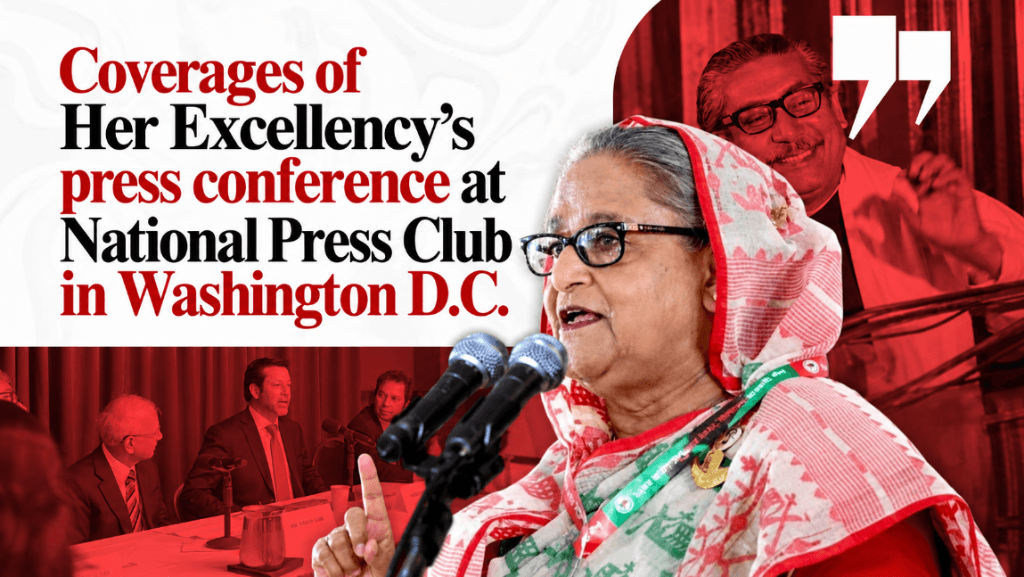
Coverages of Her Excellency’s press conference at National Press Club in Washington D.C.
Indian, Bangladeshi and international media coverage of Her Excellency Sheikh Hasina’s press conference at the National Press Club in Washington, D.C. — the full list of outlets, with a link to each report.
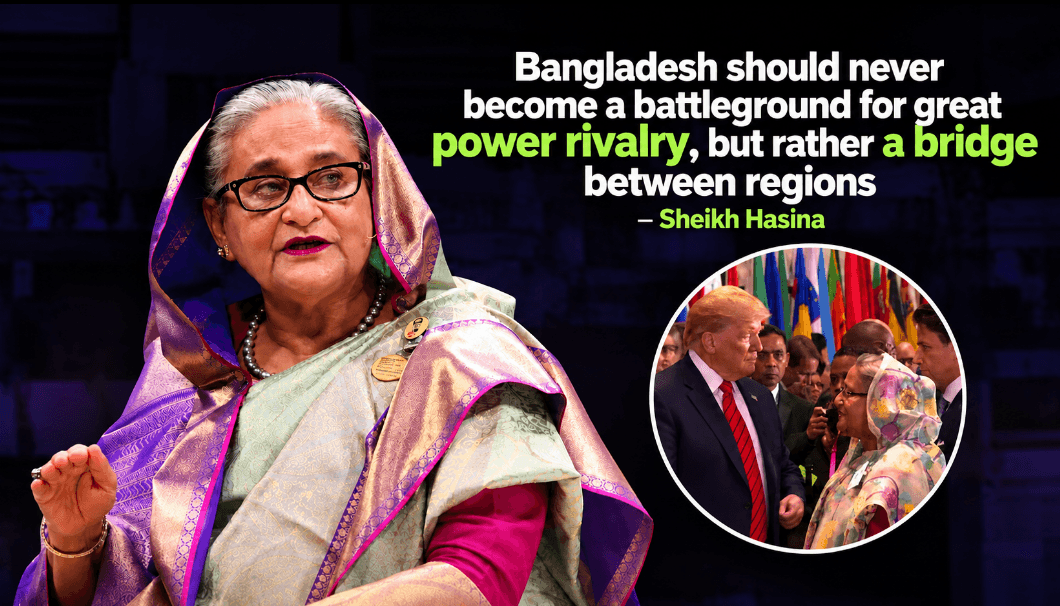
I Ask Washington to Choose Democracy
Speaking from Washington, D.C., Sheikh Hasina asks the United States not to pick a side in Bangladesh, but to stand for free elections, independent courts, due process and a future built on reconciliation, not revenge.
Sheikh Hasina’s interview with PTI: return to Bangladesh, India ties and the economy
In an interview with the Press Trust of India, Sheikh Hasina speaks on her return to Bangladesh, the death sentence, India–Bangladesh relations, Teesta, the economic downturn, the measles crisis and the 2024 protests.