From the daughter of Bangladesh’s founding leader to one of the country’s most influential political figures, Sheikh Hasina’s journey has been shaped by personal tragedy, political commitment, democratic struggle, repeated threats to her life, electoral victories and a long period of economic and infrastructural transformation.
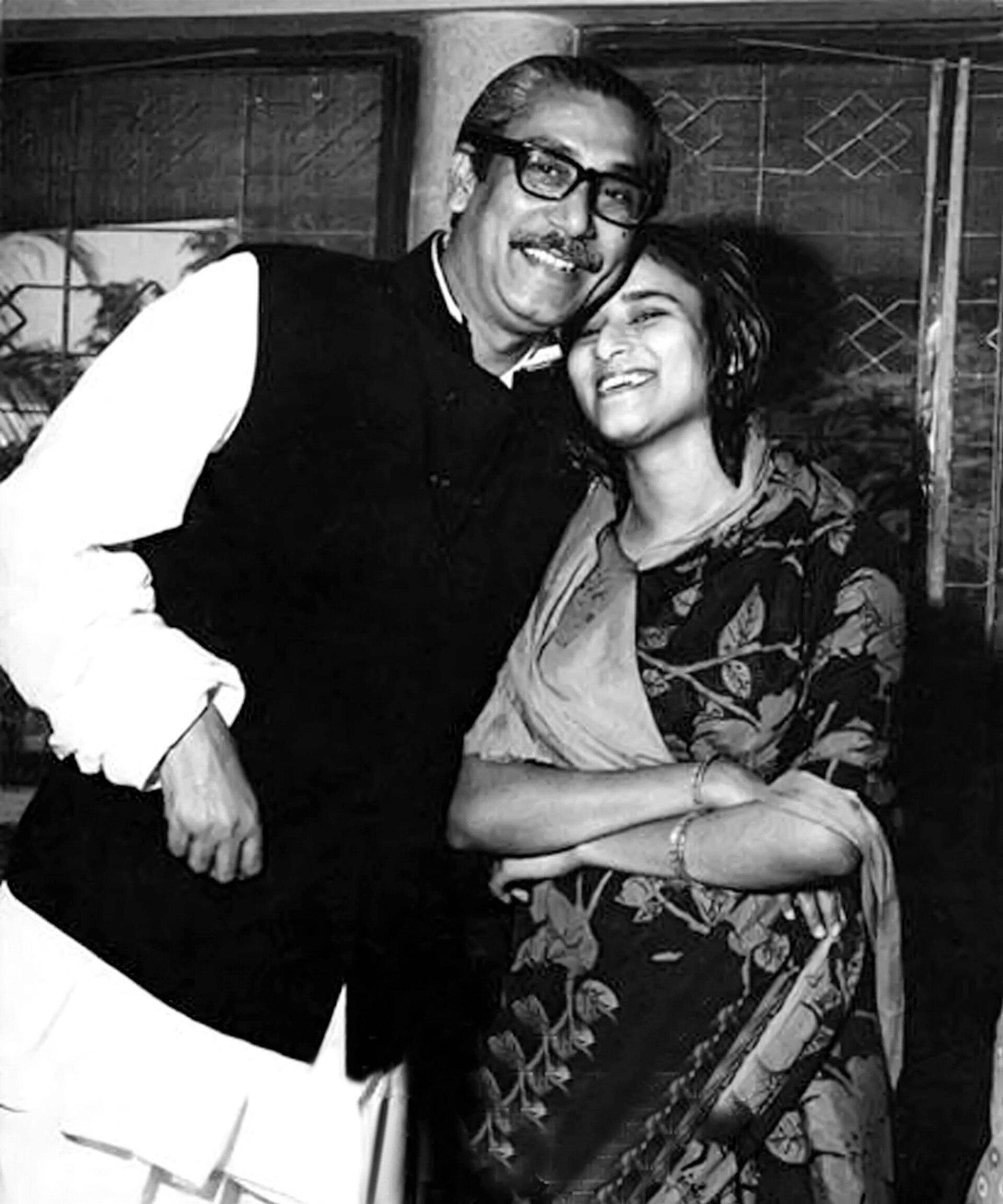
With Sheikh Mujibur Rahman
Press Information Department · Public domain
Sheikh Hasina was born on 28 September 1947 in Tungipara, Gopalganj, the eldest daughter of Bangabandhu Sheikh Mujibur Rahman and Sheikh Fazilatunnesa Mujib. [source] She studied at the University of Dhaka and graduated in 1973. Her political involvement began during her student years, when she participated in the student movement and held leadership positions in Bangladesh Chhatra League.
Her early political life was shaped by the national movement that led to Bangladesh’s independence. As the daughter of Sheikh Mujibur Rahman, she grew up in an environment where politics, nationalism and public service were closely connected. Over time, she became an active organiser, campaigner and party leader who worked to rebuild the Awami League during one of the most difficult periods in its history.
But the defining rupture in her early life came on 15 August 1975. Sheikh Mujibur Rahman and most members of his family were assassinated in a military-led coup. Sheikh Hasina and her younger sister Sheikh Rehana survived because they were abroad at the time. Hasina subsequently spent roughly six years in exile, much of that period in India. [source] The personal tragedy would later become inseparable from her political identity and her commitment to the Awami League.
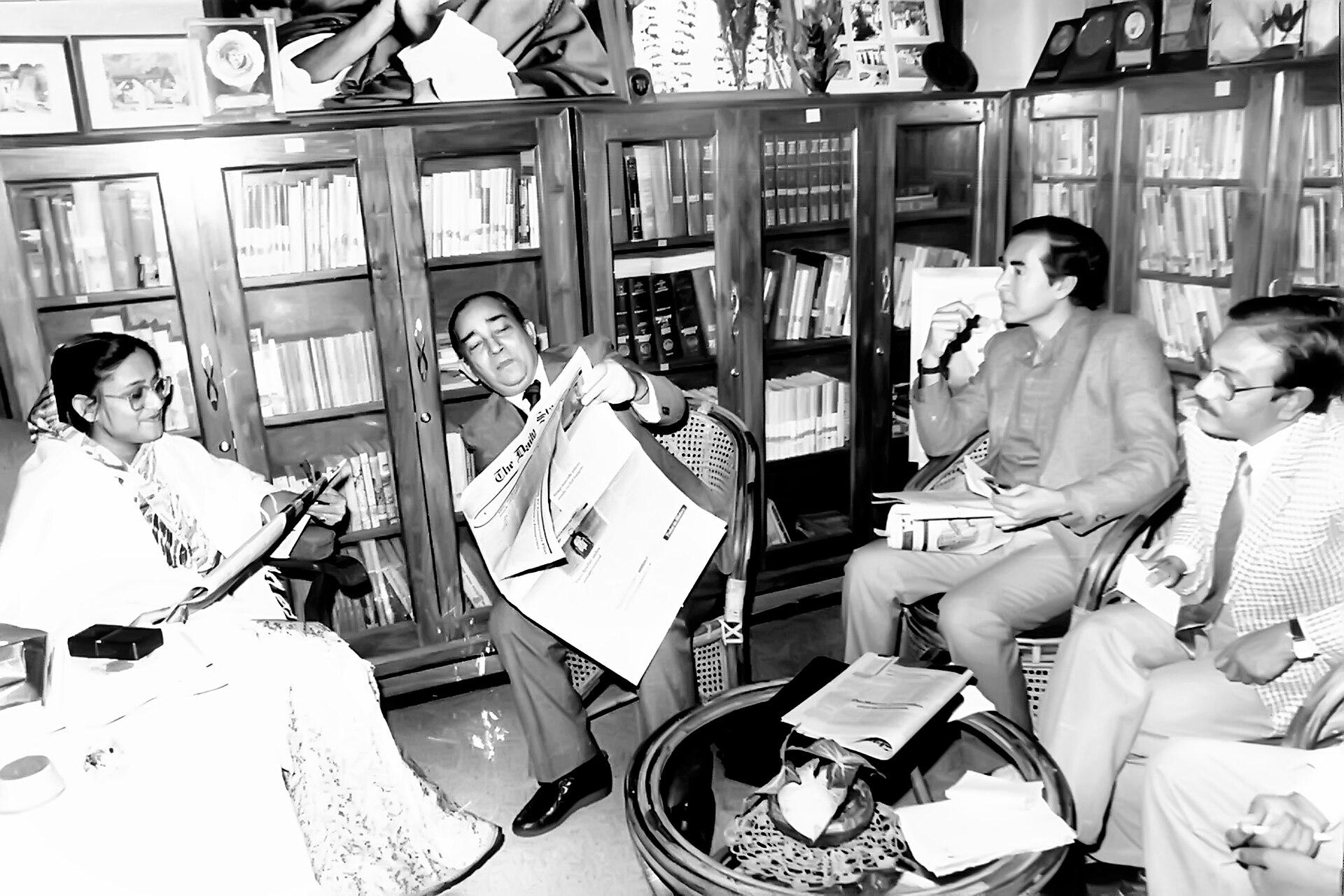
With newspaper editors, 1990 — the decade after her return
ShajiaJoty · CC0
Rebuilding the Awami League
In 1981, while she was still abroad, Sheikh Hasina was elected president of the Bangladesh Awami League. On 17 May 1981, she returned to Bangladesh and took responsibility for rebuilding the party. [source]
She travelled across the country, met party workers, strengthened local committees and reconnected the organisation with farmers, workers, students, women and grassroots communities. During the 1980s, her political work was closely linked to the movement for the restoration of parliamentary democracy.
She organised rallies, led political programmes and worked with other democratic forces against military-backed rule. Through this period, she gradually developed from the daughter of a national leader into the central figure of the Awami League.
Returning to Bangladesh
Sheikh Hasina’s return placed her at the centre of a difficult political struggle. The years that followed were marked by arrests, political pressure, surveillance and repeated attacks.
One major attack came in January 1988, when police opened fire on a procession she was leading in Chattogram; contemporary reports said more than 24 people were killed. [source] In August 1989, armed attackers also fired on the Dhanmondi residence where she had lived.
Despite these dangers, she continued to travel across Bangladesh and lead political programmes. Her efforts helped keep the Awami League active during a period when democratic institutions were under pressure.
A leading figure in the anti-autocracy movement
Supporters of Sheikh Hasina often describe her as a defender of democracy because of her role in the movement against military and authoritarian rule. During the 1980s, she worked with other opposition parties to demand the restoration of an elected parliamentary system.
The movement reached a decisive stage in 1990, when mass protests and coordinated opposition action led to the resignation of President Hussain Muhammad Ershad. Sheikh Hasina was one of the leading figures in that movement.
The democratic transition involved students, workers, professionals, civil-society groups and opposition parties across the country. Sheikh Hasina’s leadership gave the Awami League a central role in that struggle.
Her democratic credentials were also connected to the 1996 movement for a neutral election-time administration. The Awami League and other opposition parties demanded reforms to ensure that national elections would be conducted under a non-partisan caretaker government. The caretaker system was later introduced through the Thirteenth Amendment to the Constitution. [source]
Twenty One assassination attempts
The exact historical count of attacks is generally presented through statements by Sheikh Hasina, her party and close aides. Her political aides have repeatedly stated that she survived 21 assassination attempts after returning to Bangladesh in 1981. [source]
The most devastating was the 21 August 2004 grenade attack on an Awami League rally on Bangabandhu Avenue in Dhaka. Sheikh Hasina survived, but 22 Awami League leaders and activists were killed, including Ivy Rahman, while many others were injured. [source] The attack left Hasina with impaired hearing. The event remains one of the darkest episodes in Bangladesh’s political history and a defining moment in her personal political journey.
The attack also had a lasting impact on the Awami League. Many of the victims were senior party organisers and grassroots activists. Every year, the party commemorates 21 August as a day of mourning and remembrance.
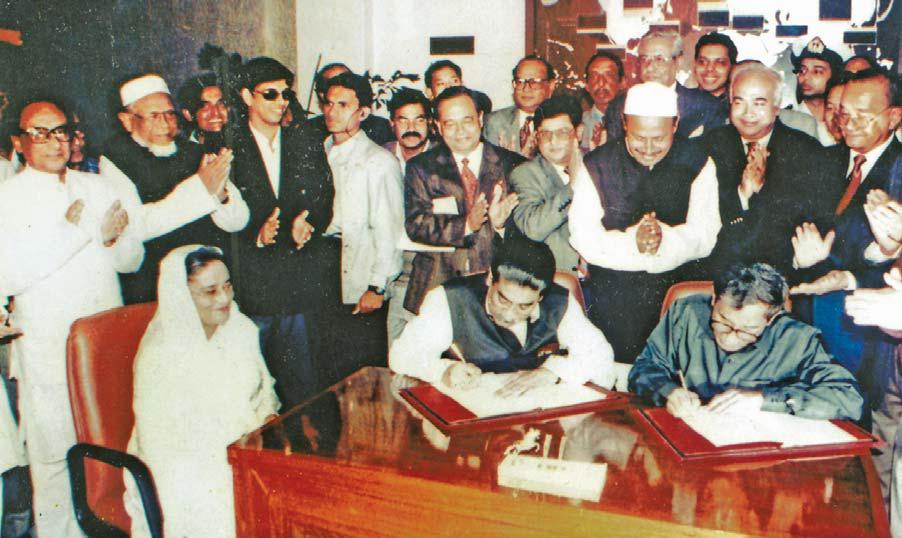
Chittagong Hill Tracts Peace Accord, 2 December 1997
Government of Bangladesh · EdictGov-Bangladesh
The first government: 1996–2001
The political journey reached a major milestone when the Awami League won the June 1996 parliamentary election, bringing Sheikh Hasina to the office of Prime Minister for the first time. She served from 23 June 1996 to 15 July 2001. [source] [source]
Her first government focused on national reconciliation, regional diplomacy, peace-building and social development. One of its most significant achievements was the 30-year Ganges Water Sharing Treaty, signed with India on 12 December 1996. The treaty established a framework for sharing Ganges water during the dry season and remains an important milestone in Bangladesh-India relations. [source]
Another major achievement was the Chittagong Hill Tracts Peace Accord, signed on 2 December 1997 after more than two decades of conflict. The agreement established a framework for peace, regional administration and the rights of indigenous communities. For her role in advancing peace, Sheikh Hasina received the UNESCO Félix Houphouët-Boigny Peace Prize in 1998. [source]
Her first government also expanded programmes for primary education, food security, rural development, agricultural support and women’s empowerment. The Ashrayan programme, which later became one of the government’s major social initiatives, was designed to provide housing and rehabilitation for landless and homeless families. [source]
The government also promoted roads, bridges and rural connectivity, laying part of the foundation for larger infrastructure programmes pursued after 2009.
Opposition, imprisonment and the road back
The Awami League lost the 2001 parliamentary election, and Sheikh Hasina returned to the opposition. The following years were marked by political confrontation and increasing security threats. [source]
In 2007, during the military-backed caretaker government, she was arrested and detained. Her eventual release allowed her to return to active politics and prepare for the next national election. [source]
The turning point came with the 2008 parliamentary election. The Awami League-led Grand Alliance won a landslide victory, taking roughly two-thirds of the parliamentary seats. Sheikh Hasina returned as Prime Minister in January 2009, beginning what would become her longest continuous period in office. [source] [source]
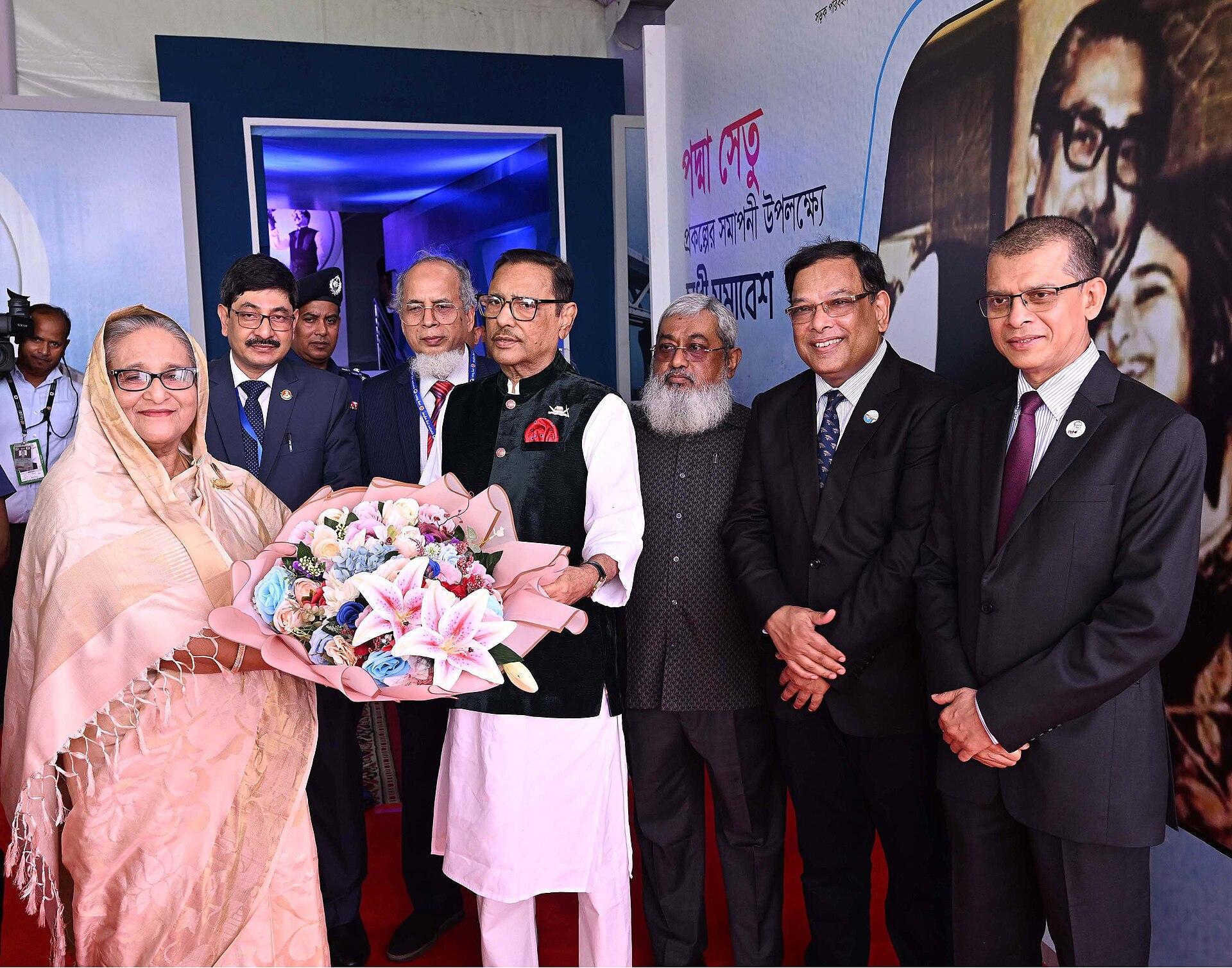
Padma Bridge project conclusion, 5 July 2024
Press Information Department · Public domain
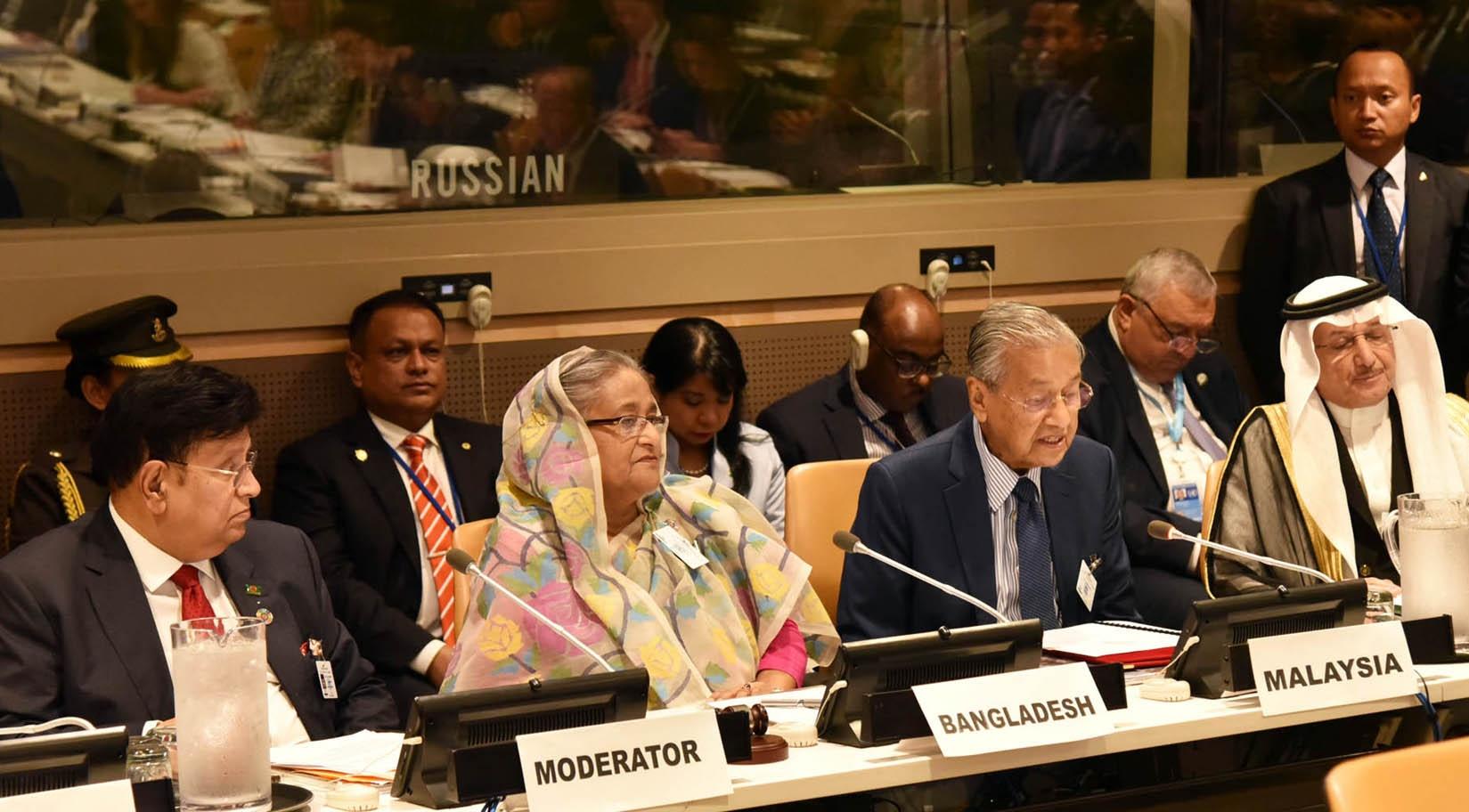
UN meeting on Rohingya minorities, 24 September 2019
Press Information Department · Public domain
The transformation of Bangladesh: 2009–2024
From 2009 to 2024, Bangladesh experienced a broad transformation in infrastructure, electricity, education, digital services, industry and social development. [source]
The government introduced the vision of “Digital Bangladesh,” expanded electricity generation and rural electrification, improved roads and bridges, strengthened education programmes and expanded social-safety-net initiatives. [source] The garment industry grew, remittances remained important and the country’s export base gradually expanded.
Large infrastructure projects became central to this period of development. The Padma Bridge, opened in 2022, connected the country’s southwest with Dhaka and became a symbol of national confidence and infrastructure progress. The Dhaka Metro Rail introduced a new form of mass transportation to the capital, while expressways, highways, bridges, power plants, railway improvements and port facilities strengthened national connectivity.
Electricity access expanded sharply. The World Bank reports that Bangladesh reached 99.5% electricity access in 2024. [source] GDP per capita increased from approximately $396.7 in 2000 to $2,593.4 in 2024, measured in current US dollars. [source]
Bangladesh also made progress in reducing poverty, expanding rural infrastructure and improving access to basic services. The World Bank has highlighted the country’s progress in primary-school enrolment, gender parity in education and female labour-force participation. [source] [source]
Digital public services expanded through Union Digital Centres, online education, digital payment systems, mobile financial services and technology-based administration. Citizens gained easier access to birth registration, land records, certificates and other public services. [source]
The government also expanded free textbook distribution, student stipends, agricultural cards, Tk 10 bank accounts for farmers and social-safety-net programmes.
Women occupied an important place in this development story. The World Bank reports that Bangladesh achieved gender parity in school enrolment and that female labour-market participation increased by 32 percentage points between 2000 and 2022. [source]
The garment industry became a major source of employment for women from rural and lower-income households. Women also became increasingly visible in public administration, education, healthcare, law enforcement and local government.
During this period, the government pursued security measures against militant organisations and religious extremism. Following major militant attacks, including the 2016 Holey Artisan Bakery attack, counterterrorism operations were intensified.
Internationally, Bangladesh expanded its relationships with India, China, Japan, the United States, the European Union and countries in the Middle East. Regional connectivity through road, rail, river and energy links also became an important part of the country’s foreign-policy agenda.
Bangladesh’s response to the Rohingya crisis became another major feature of this period. In 2017, hundreds of thousands of Rohingya refugees crossed the border from Myanmar. Bangladesh provided shelter, food, healthcare and education with support from international agencies. By 2023, Bangladesh was hosting around one million Rohingya refugees. [source]
During these years, Bangladesh also graduated from the United Nations category of least developed countries, reflecting progress in income, human development and economic vulnerability indicators. [source]
Five times Prime Minister
Sheikh Hasina’s political career is unusually long. She has been elected to Parliament eight times, beginning with the 1986 election cycle and continuing through the 2024 election. She has also served as Prime Minister five times, following the elections of 1996, 2008, 2014, 2018 and 2024. [source] [source]
Her parliamentary electoral record includes victories from Gopalganj-3 in 1991, 1996, 2001, 2008, 2014, 2018 and 2024, alongside victories from additional constituencies during several elections. In the 2024 election, she won Gopalganj-3 with 249,962 votes according to reported results. [source]
Her long tenure gave her the opportunity to pursue policies over several electoral cycles. Large infrastructure projects, education reforms, electricity expansion and digital programmes often required years of planning and implementation.
The numbers behind the transformation
Several figures help explain the scale of Bangladesh’s development during Sheikh Hasina’s political career:
- 1981Returned to Bangladesh and assumed leadership of the Awami League
- 1990Played a leading role in the anti-autocracy movement
- 1996Began her first term as Prime Minister
- 1996Signed the Ganges Water Sharing Treaty
- 1997Signed the Chittagong Hill Tracts Peace Accord
- 2001Returned to opposition
- 2004Survived the 21 August grenade attack
- 2007Arrested during the military-backed caretaker government
- 2008Returned to power with a landslide election victory
- 2017Bangladesh received hundreds of thousands of Rohingya refugees
- 2022Padma Bridge opened to traffic
- 2022Bangladesh’s GDP per capita reached approximately $2,716.5
- 2024Electricity access reached 99.5%
- 2024Elected to Parliament for the eighth time
- 2024Began her fifth period as Prime Minister
A journey defined by resilience
On 5 August 2024, Sheikh Hasina left office amid widespread unrest and a serious national crisis, bringing an end to her long period in government. Her political journey therefore spans more than four decades—from a young woman returning from exile in 1981 to one of Bangladesh’s longest-serving Prime Ministers.
Her legacy is closely associated with economic growth, infrastructure, electricity expansion, poverty reduction, women’s education, digitalisation, counterterrorism, peace-building and international diplomacy. Supporters also credit her with protecting the Awami League’s organisational strength, defending the memory of the Liberation War and preserving the party’s role in national politics.
Yet measured purely as a political journey, the trajectory is extraordinary: a childhood shaped by the birth of Bangladesh, a family tragedy that changed her life, six years in exile, a return to a politically turbulent country, repeated threats to her life, imprisonment, leadership of the democratic movement, five periods as Prime Minister and eight parliamentary victories.
Sheikh Hasina’s story is, above all, a story of endurance and political determination. It is also a story that became intertwined with the transformation of Bangladesh itself—from a country struggling with poverty, political instability and weak infrastructure to a more connected, electrified, digitally enabled and economically ambitious nation.
What cannot be denied is the scale of her influence. Sheikh Hasina shaped the Awami League, led Bangladesh through several major phases of national development and became one of the most consequential political figures in the country’s history.
Sources
The biography above draws on the sources below. Citation numbers in the text link down to the matching entry.
- [1] Ministry of Defence, Government of Bangladesh — "Biography of Sheikh Hasina" mod.gov.bd ↗
- [2] The Daily Star — report on attacks against Sheikh Hasina and the 1988 Chattogram incident thedailystar.net ↗
- [3] bdnews24.com — "PM Sheikh Hasina’s assailants still active even after 19 attempts on her life, says close aide" bdnews24.com ↗
- [4] BDC GTA Toronto — statement concerning the 21 August 2004 grenade attack bdcgtoronto.ca ↗
- [5] Wikipedia — "Premiership of Sheikh Hasina" en.wikipedia.org ↗
- [6] Ministry of Water Resources, Government of India — Ganges Water Sharing Treaty, 1996 mowr.nic.in ↗
- [7] University of Notre Dame, Peace Accords Matrix — "Chittagong Hill Tracts Peace Accord" peaceaccords.nd.edu ↗
- [8] Associated Press — reports on Sheikh Hasina’s political career, detention and the Rohingya crisis apnews.com ↗
- [9] Parliament of Bangladesh — parliamentary publication and election-related information parliament.gov.bd ↗
- [10] World Bank DataBank — Bangladesh GDP per capita data databank.worldbank.org ↗
- [11] World Bank Open Data — Bangladesh country indicators, including electricity access and development data data.worldbank.org ↗
- [12] Bangladesh Delta Plan 2100 Knowledge Portal — profile of the Prime Minister and government development initiatives bdp2100kp.gov.bd ↗
- [13] World Bank — "Bangladesh: A Fifty-Year Partnership in Development Achievements" worldbank.org ↗
- [14] Jagonews24 — report on the 2024 parliamentary election result in Gopalganj-3 jagonews24.com ↗
- [15] bdnews24.com — report on Sheikh Hasina’s parliamentary and Prime Ministerial record bdnews24.com ↗