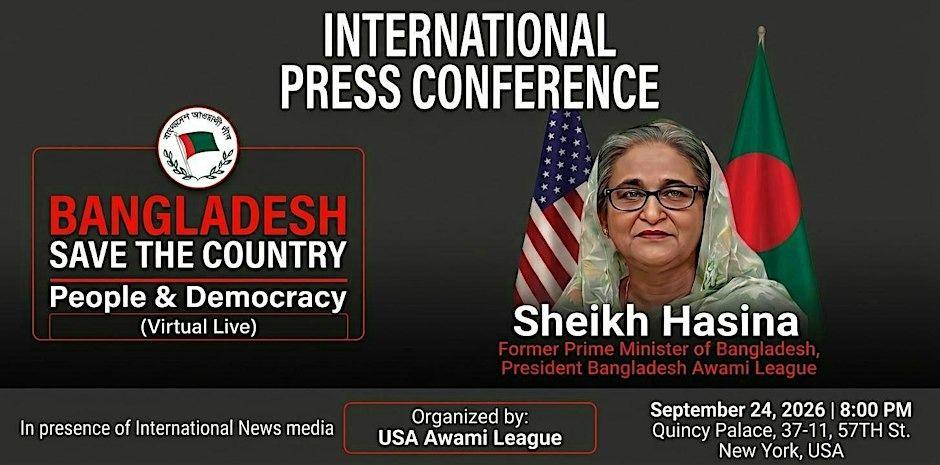
Bangladesh: Save the Country, People and Democracy
Address by H.E. Sheikh Hasina to an international press conference in New York — on the crisis of governance, security, justice and public confidence facing Bangladesh.
Distinguished journalists, respected guests, friends of Bangladesh, ladies and gentlemen, Assalamu Alaikum and good evening.
I thank all of you for joining me today. I also thank the journalists who continue to follow developments in Bangladesh at a time when finding and reporting the truth has become increasingly difficult. In recent weeks, journalists have asked me again and again: what has happened to Bangladesh? I ask myself the same question every day. For more than two years, I have been away from my country, but I have never been away from my people.
Every day I hear from Bangladesh. I hear from families who have lost loved ones, workers who have lost their jobs, farmers struggling to obtain fertiliser, businesspeople trying to keep factories running, mothers worried about their children, minority families who no longer feel secure, and political workers who have been arrested or forced into hiding. Their experiences may be different, but together they tell us something very serious: Bangladesh today is facing a profound crisis of governance, security, justice and public confidence.
What happened in July and August 2024 did not bring peace or prosperity to the people. It weakened the institutions of the state and changed the direction in which Bangladesh had been moving. During our years in government, we worked to improve people's lives. We expanded electricity across the country, increased food production, built roads, bridges, power plants, community clinics and other essential infrastructure. Industries expanded, employment grew, and Bangladesh became known internationally as a country moving forward.
Today, ordinary people are once again struggling with problems that we had spent years trying to overcome. Electricity and gas shortages are affecting homes and factories. Industries are closing or reducing production. Workers are losing employment. Farmers are struggling to obtain fertiliser, and in some places, those demanding fertiliser have themselves faced harassment. The cost of everyday life has become unbearable for many families. At the same time, law and order has deteriorated seriously.
Every day people see reports of murder, extortion, mob violence and brutal attacks. We have even witnessed horrifying incidents in which a woman has been killed while feeding her children. From young children to elderly citizens, people increasingly feel that no one is safe. Yet while violent criminals often appear to move freely, law-enforcement agencies are being used extensively to arrest and prosecute Awami League leaders, workers and supporters. This is not the purpose of law enforcement. The first responsibility of any government is to protect the life and property of its people.
The persecution of Awami League leaders and workers has continued without pause. On 16 July 2024, Bangladesh Chhatra League activist Sabuj Ali was killed at Dhaka University, and from that day the killing of Awami League and its affiliated organisations' leaders and workers began. It has still not stopped. Across the country, at least ten thousand leaders and activists have been killed or disappeared, while more than seven hundred thousand have been arrested at different times and sent to prison. Even inside prison, our leaders and workers have been killed.
At least ten million people have been forced from their homes across the country. When political activists could not be found at home, even their family members were targeted. Mothers and aunts have been burned to death, and sisters have been raped. Raihan and Masud, two young men, were hacked to death simply for saying "Joy Bangla." Homes and businesses belonging to Awami League leaders and workers have been vandalised and occupied. In Gopalganj, five people were killed by the army with state backing. I do not know of another civilised democratic country where political vengeance has been carried out on such a scale.
The deterioration of basic services has become equally painful. More than one thousand children have died during the present measles outbreak, and dengue is again spreading, placing further pressure on families and hospitals.
This is particularly heart-breaking because we had built one of the strongest immunisation programmes in the world. We had an established EPI system, trained health workers, high vaccination coverage and long-standing cooperation with UNICEF, GAVI and WHO. We had a functioning system in place, but after 5 August 2024 that continuity was broken. Vaccination campaigns were delayed, vaccine procurement was disrupted, and warnings about shortages were not acted upon with the urgency they required. Children died from a disease that could have been prevented. These are not just numbers. These were children whose lives might have been saved. This is why I say that Bangladesh's present crisis is not simply political. It is affecting every part of people's lives.
One of the most dangerous consequences has been the renewed rise of violent extremism. Bangladesh has experienced this before. Between 2001 and 2006, militant organisations grew while the seriousness of the threat was repeatedly denied. Bangla Bhai was initially dismissed as a creation of the media. Then Bangladesh witnessed coordinated bomb attacks across almost the entire country. The British High Commissioner was attacked in Sylhet. The ten-truck arms haul revealed how Bangladesh was being used for regional militant activities. And on 21 August 2004, grenades were thrown at an Awami League rally in an attempt to eliminate our leadership. Twenty-four people were killed and hundreds were injured.
When the Awami League returned to government in 2009, we made counterterrorism a national priority. We strengthened intelligence coordination, acted against terrorist financing, developed specialised counterterrorism institutions and worked with religious scholars, teachers, families and communities. For years, Bangladesh succeeded in containing extremist networks. That progress is now under threat.
Since August 2024, prisons have been attacked. Militants have escaped or been released. Extremist figures have returned to public activity. Officers with years of counterterrorism experience have been removed, side-lined, arrested or prosecuted. Explosive devices and suspected militant activities have again appeared in different parts of the country. The danger may be denied today, just as it was denied in the past, but Bangladesh has already paid a terrible price once for ignoring these warning signs.
Once extremist forces are given political space, they do not remain under anyone's control. Terrorism does not recognise national borders either. If these networks are allowed to establish themselves again in Bangladesh, the consequences will reach India, Myanmar, the Bay of Bengal and beyond.
The insecurity faced by religious minorities is another deeply disturbing sign of the direction in which the country is moving. Bangladesh was founded on equal citizenship. The Father of the Nation, Bangabandhu Sheikh Mujibur Rahman, envisioned a country where Hindus, Muslims, Buddhists, Christians and people of every faith would live together with equal rights, dignity and security.
Yet today many of our Hindu brothers and sisters are living with a deep sense of insecurity. The recent brutal murder of the respected teacher Ganapati Chakraborty and his family in Rangpur has yet to receive the credible and impartial investigation that such a horrific crime requires. Instead, a new "Joj Mia" style narrative has been constructed to bury the truth quickly. In Bhaluka, individuals accused of the brutal daylight killing of Dipu Chandra Das, including those who have admitted their involvement, have been granted bail. At the same time, Chinmoy Prabhu, detained for nearly two years in false and fabricated cases, was repeatedly denied the opportunity to see his ailing mother for the last time. She died without seeing her son again. Only after her death was he given five hours of parole to attend her final rites. The image of Chinmoy Prabhu crying at his mother's funeral has become a painful symbol of the helplessness and anguish felt by many Hindus in Bangladesh today.
What kind of justice allows those accused of brutal killing to walk free while a religious leader remains behind bars for speaking about the rights and security of his community? Impunity encourages further violence and destroys people's confidence in the state. We did not liberate Bangladesh so that any citizen would one day have to live in fear because of his or her religion.
These failures in security, public health, the economy and minority protection all point to a deeper problem: the weakening of democratic and constitutional institutions. The Bangladesh Awami League has been prevented from functioning normally. Its political activities have been restricted. Its leaders and workers are being killed, tortured, arrested, and forced into hiding. Millions of citizens who support the party have effectively been excluded from political life. This cannot be called democracy.
People have every right to criticise me or the Awami League. They can campaign against us, and they can vote against us. That is democracy. But democracy cannot mean taking away the political rights of millions of people simply because of the party they support. If those now in power genuinely believe that the people have rejected the Awami League, there is a very simple democratic test. Allow the Awami League to organise. Allow every political party to campaign freely. Then let the people decide. Political legitimacy must come from the ballot box, not from bans, administrative orders or politically directed judicial processes.
Unfortunately, the justice system itself is increasingly being used as an instrument of political exclusion. The International Crimes Tribunal was created for an important and historic purpose: to bring to justice those responsible for war crimes and crimes against humanity committed during our Liberation War of 1971. Today, that institution is being used against leaders of the political force that led that Liberation War. Senior leaders of the Awami League, Jubo League and Chhatra League have been sentenced to death in their absence. Serious questions remain regarding defence rights, access to evidence, legal representation, cross-examination of witnesses, forensic examination and internationally recognised standards of a fair trial. I reject these politically motivated verdicts.
In July 2024, I myself established a Judicial Inquiry Commission to investigate deaths, injuries and violence. After Muhammad Yunus took power, that inquiry was stopped. At the same time, indemnity was given to those associated with the movement. Why was the investigation stopped? Why was indemnity necessary? If the objective was justice, why prevent a full investigation? These questions remain unanswered.
I also want to address the members of our armed forces, police, and other law-enforcement agencies. Today, however, these institutions are being used overwhelmingly to persecute Awami League leaders, workers and supporters. I want to remind every member of our armed forces and law-enforcement agencies that their duty is not to serve the political interests of those temporarily in power. Their duty is to Bangladesh, to the Constitution and to the people. The honour of the uniform must not be damaged by unlawful orders, political persecution or partisan conduct. People remember how state power is used, and history remembers it too. Those who wear the uniform carry not only authority, but also responsibility for the dignity and reputation of the institutions they represent.
And today I make an equally serious appeal to the international community. What is happening in Bangladesh cannot be dismissed as an internal disagreement between political parties. The growth of extremism, the insecurity of minorities, the weakening of judicial independence and the exclusion of millions of citizens from political life have implications well beyond our borders. A stable, democratic and secular Bangladesh contributes to peace and security throughout South Asia. An unstable Bangladesh creates risks for its neighbours, for the Bay of Bengal, for migration, trade, maritime security and international counterterrorism cooperation.
I therefore call upon the United Nations, democratic governments, international human-rights organisations, development partners and all friends of Bangladesh to engage with the situation in our country seriously and consistently. I am not asking any foreign government to decide who should govern Bangladesh. That right belongs only to the people of Bangladesh. But the international community should stand for the same principles in Bangladesh that it supports elsewhere: democracy, human rights, free political participation, judicial independence and protection of minorities.
Today, therefore, our demands are clear. The ban and all restrictions on the political activities of the Bangladesh Awami League must be withdrawn immediately, and its right to function peacefully and lawfully must be restored. All political prisoners must be released, and arbitrary arrests, intimidation and political persecution must end. False and politically motivated cases against political leaders, activists, journalists, lawyers and ordinary citizens must be withdrawn. Freedom of speech, media freedom and the right to peaceful political assembly must be restored. Judicial independence, due process and constitutional governance must be guaranteed, and courts and tribunals must never be used as instruments of political revenge. Minority communities, cultural institutions, secular voices and every citizen, regardless of religion or political belief, must receive equal protection under the law. And Bangladesh and the international community must urgently confront the renewed threat of terrorism, violent extremism and transnational militant networks.
I have seen my country face difficult times before. In 1975, I lost almost my entire family. I spent six years in exile. When I returned in 1981, the killers of my family still enjoyed immunity. I faced military rule, imprisonment and repeated attempts on my life. I survived the grenade attack of 21 August. So, I know what fear means. But fear has never decided my duty. Today, I am not thinking about my own future. I am thinking about Bangladesh.
I am thinking about the farmer waiting for fertiliser, the worker who wants his factory to remain open, the mother who wants medicine and vaccines for her child, the minority family that wants to live and worship without fear, the journalist who wants to report the truth, and the young person who deserves hope and opportunity in his or her own country.
Bangladesh has been through difficult times before, and we have come through them. I know the road ahead will not be easy, but I also know the strength of our people. The Awami League has faced assassination, military rule, imprisonment and persecution before. We remained because this party was born from the people and from the struggle for Bangladesh. We will not respond to injustice with revenge. We will follow the Constitution, we will follow the democratic path, and we will place our trust in the people.
I have spent my life with the people of Bangladesh. I have seen their courage in the most difficult moments. I believe in them. I will fight to give the people back their democratic rights, to restore their voice, and to ensure that they themselves can decide the future of Bangladesh. They will put Bangladesh back on the right path. That is my faith. That is my commitment.
Joy Bangla. Joy Bangabandhu. May Bangladesh live forever.
More from the blog
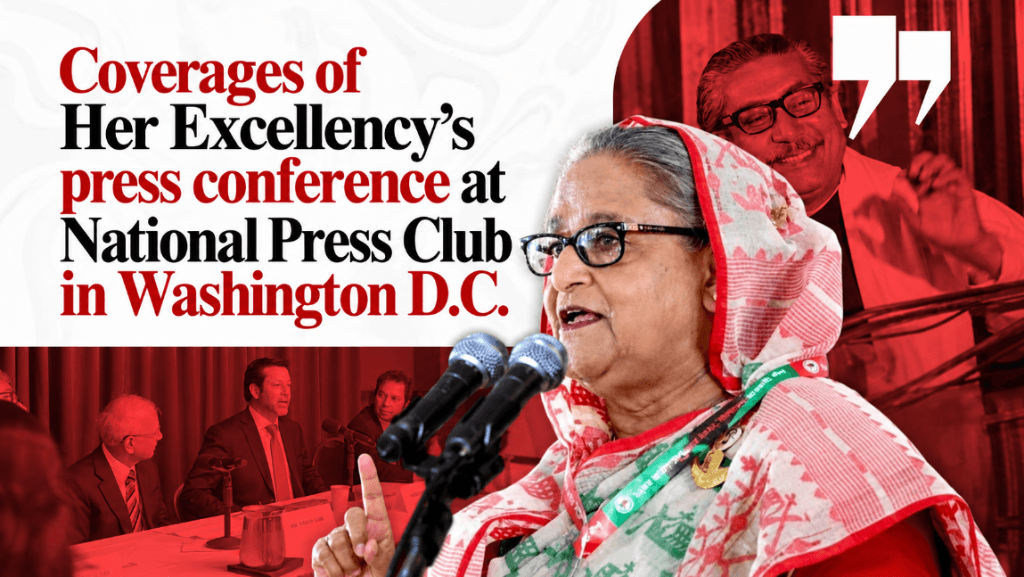
Coverages of Her Excellency’s press conference at National Press Club in Washington D.C.
Indian, Bangladeshi and international media coverage of Her Excellency Sheikh Hasina’s press conference at the National Press Club in Washington, D.C. — the full list of outlets, with a link to each report.
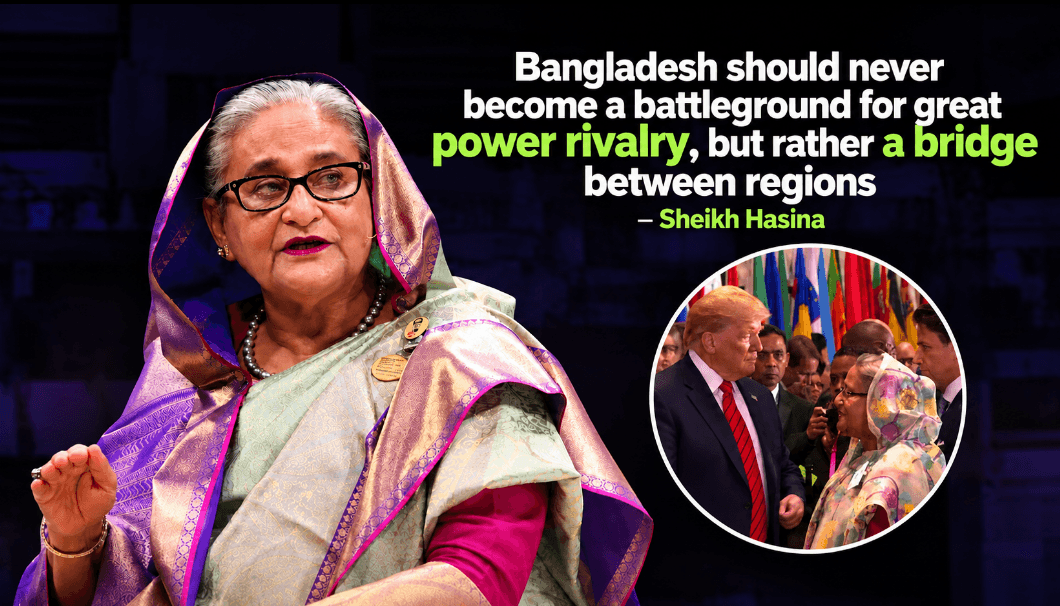
I Ask Washington to Choose Democracy
Speaking from Washington, D.C., Sheikh Hasina asks the United States not to pick a side in Bangladesh, but to stand for free elections, independent courts, due process and a future built on reconciliation, not revenge.
Sheikh Hasina’s interview with PTI: return to Bangladesh, India ties and the economy
In an interview with the Press Trust of India, Sheikh Hasina speaks on her return to Bangladesh, the death sentence, India–Bangladesh relations, Teesta, the economic downturn, the measles crisis and the 2024 protests.