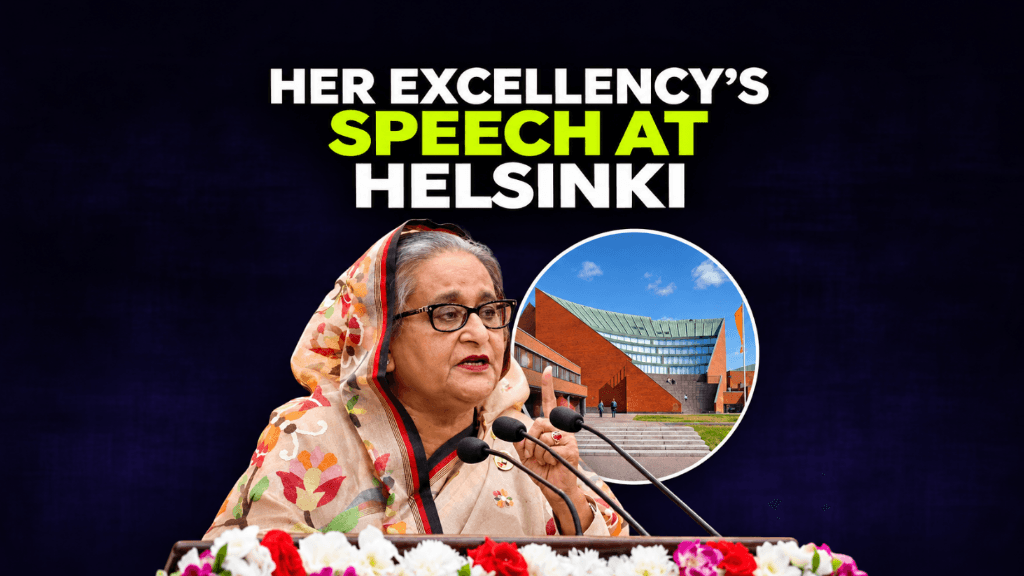
Bangladesh at a Turning Point: Democracy, Human Rights, and Extremism
Virtual address by H.E. Sheikh Hasina at Aalto University, Helsinki, organised by the Global Center for Democratic Governance — on political persecution, the suffering of women and children, rising extremism and the halted inquiry into July and August 2024.
Distinguished guests, respected speakers, human rights advocates, friends of Bangladesh, ladies and gentlemen,
Assalamu Alaikum and good evening.
I thank the Global Center for Democratic Governance for organising this gathering and giving me the opportunity to speak about my beloved Bangladesh.
A country under threat
For more than two years, I have watched with great pain what is happening to my country. The democratic rights for which our people struggled and sacrificed are under serious threat. Political persecution continues, law and order have deteriorated, and ordinary people are suffering terribly.
I am particularly disturbed by the situation of women and children. According to a recent human rights report, 253 women and girls were raped between July and September this year. Among them, 154 were children, and twelve victims were killed after being raped. Just imagine the suffering of their families.
Our children are also facing a terrible health crisis. More than 1,250 children have died of measles since March. During our government, Bangladesh had an extensive immunisation system that helped bring child mortality down substantially. Seeing children lose their lives to a preventable disease is heart-breaking.
Economic hardship has added to this suffering. Hundreds of factories have closed over the past two years, leaving thousands of our hardworking people without work, including women who depended on their earnings to support their families. Extortion, violence and insecurity have made ordinary life increasingly difficult.
Even speaking about these problems can bring punishment. Recently, Sathi Akter, a woman entrepreneur in Mymensingh, was arrested after criticising the government over repeated thefts at her business.
What kind of democracy sends a woman to prison for expressing her frustration?
What we built
My dear friends,
During our government, we worked to build a Bangladesh where women could live with dignity and children could grow up with better opportunities. We expanded girls’ education, introduced policies to strengthen women’s rights, established around 14,000 community clinics and improved maternal and child healthcare. Poverty fell from 41 percent to 18.6 percent. Millions of families gained access to electricity, education and healthcare. Women entered employment and public life in greater numbers. These achievements came through years of hard work and careful planning.
Peace has always been an important part of my political life. In 1997, we signed the Chittagong Hill Tracts Peace Accord to end decades of armed conflict. When hundreds of thousands of Rohingya fled persecution in Myanmar in 2017, Bangladesh opened its borders and gave them shelter. We did so because protecting human life was our responsibility.
We also maintained a policy of zero tolerance towards terrorism. We strengthened our intelligence and law enforcement institutions and took action against militant networks. Today, I am deeply concerned that extremist groups are regaining influence while experienced counterterrorism officers have faced prosecution and imprisonment. Such developments threaten Bangladesh’s secular foundations and the security of the wider region.
Persecution and distortion
But the crisis in Bangladesh goes much deeper. The Awami League, the party that led our Liberation War, has been denied its normal political rights. Thousands of our leaders and workers have been arrested, attacked or forced into hiding. And this persecution is no longer confined to the Awami League. Freedom fighters, religious minorities, journalists, cultural activists and ordinary citizens are also living under fear and intimidation.
Alongside this repression, a systematic campaign has been carried out to destroy my reputation and discredit the achievements of our government. Artificial intelligence has been used to create distorted and frightening images of me. Fabricated stories accusing me of killing innocent people, even children, have been spread widely through social media. Graffiti carrying these accusations appeared on walls, and photographs were quickly collected into albums and circulated across the country and abroad. Even school textbooks have been used to present children with a deeply hostile and distorted image of me and my government.
This was a deliberate attempt to mislead the people, particularly the younger generation, and turn them against me and the Awami League. The way these materials appeared and were distributed so quickly raises serious questions about how much of this campaign had been planned in advance.
The inquiry that was stopped
The same pattern can be seen in the allegations surrounding the events of July and August 2024. The figure of 1,400 deaths has repeatedly been used to hold me and my government responsible. I reject the accusations that I ordered the killing of innocent people. Every death deserves a proper investigation, and I have never opposed that. In fact, on 18 July 2024, I established a Judicial Inquiry Commission headed by a High Court judge to investigate the violence and loss of life. On 1 August, I expanded it into a three-member judicial commission to ensure a more thorough investigation.
But after Muhammad Yunus assumed power, he stopped that inquiry. Yunus himself later described the movement as “meticulously designed.” His own words raise serious questions about the organised forces behind the protests, the killings, the arson and the destruction that followed. These are matters that should have been investigated, not concealed.
And Yunus did not stop at shutting down the investigation. His administration went further, granting legal protection to participants in the uprising for acts classified as political resistance, while murder cases were brought against me and Awami League leaders and workers.
I ask a simple question.
If the intention was to establish the truth, why was the judicial inquiry stopped? Why were those accused of violence given legal protection, while the responsibility for the killings was placed on me and my party?
I know very well what political violence means to a family. In 1975, I lost my father, Bangabandhu Sheikh Mujibur Rahman, my mother, my brothers and almost my entire family. I have faced imprisonment and repeated attempts on my own life. I know the pain of losing loved ones, and I would never wish that suffering upon another family. Those experiences have only strengthened my determination to stand beside the people of Bangladesh and defend their right to justice, peace and democracy.
My appeal from Helsinki
From this gathering in Helsinki, I appeal to the United Nations, the European Union, democratic governments and human rights organisations to pay serious attention to the situation in Bangladesh.
Political persecution must end. Political prisoners must be released, restrictions on the Awami League must be withdrawn, and freedom of speech and peaceful political activity must be restored. Women, children and religious minorities must receive equal protection under the law. We need independent justice, action against violent extremism and a genuinely inclusive democratic process.
I want to see a Bangladesh where mothers no longer fear for their children’s safety, where women can work and live with dignity, and where citizens can speak freely without fear of arrest.
That is the Bangladesh I have worked for throughout my life. I still believe in my people, and I will continue to stand beside them.
Thank you.
Joy Bangla.
Joy Bangabandhu.
May Bangladesh live forever.
More from the blog
Coverages of Her Excellency’s press conference at National Press Club in Washington D.C.
Indian, Bangladeshi and international media coverage of Her Excellency Sheikh Hasina’s press conference at the National Press Club in Washington, D.C. — the full list of outlets, with a link to each report.
I Ask Washington to Choose Democracy
Speaking from Washington, D.C., Sheikh Hasina asks the United States not to pick a side in Bangladesh, but to stand for free elections, independent courts, due process and a future built on reconciliation, not revenge.
Sheikh Hasina’s interview with PTI: return to Bangladesh, India ties and the economy
In an interview with the Press Trust of India, Sheikh Hasina speaks on her return to Bangladesh, the death sentence, India–Bangladesh relations, Teesta, the economic downturn, the measles crisis and the 2024 protests.