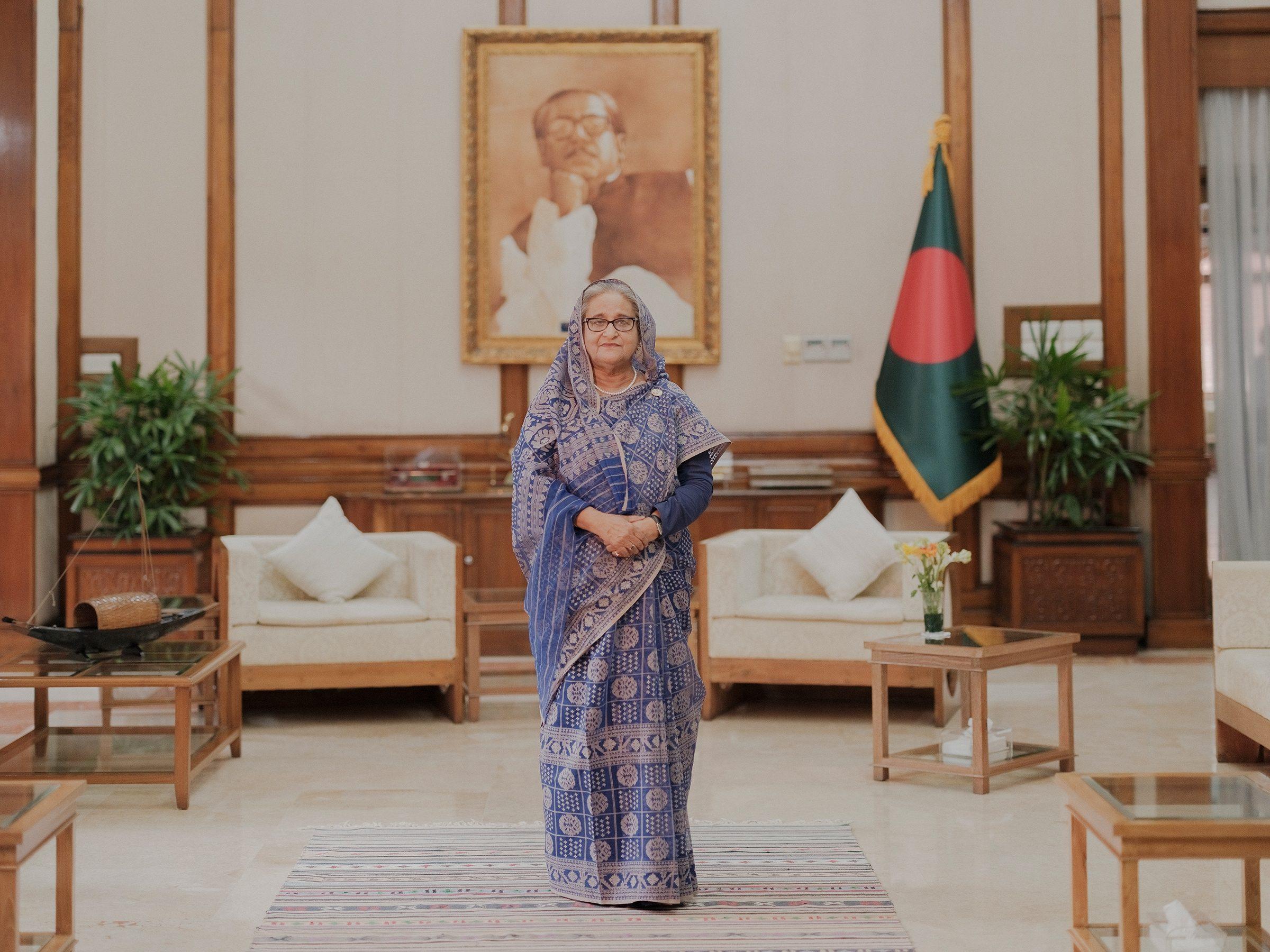
Achievements and International recognition of Sheikh Hasina
Twenty-one years as Prime Minister, 54 international awards, and a lifetime of struggle on the streets — the record of a leader recognised around the world.
Sheikh Hasina Prime Minister of Bangladesh for a long 21 years. Sheikh Hasina is the longest-serving woman head of government in power in the world. While discussing this, Arab News said, “Bangladesh dynamic leap: Sheikh Hasina’s landmark fifth term.”
Sheikh Hasina ranked 30th on TIME magazine’s list of the 100 most influential people. British media gave Sheikh Hasina the title “Mother of Humanity” for providing shelter to 1.4 million Rohingyas in Bangladesh. Speaking about Sheikh Hasina’s rule, renowned columnist Abdul Gaffar Choudhury said, “I believe that one day Sheikh Hasina’s tenure will be added to the history of Bengal as a memorable chapter, like the Hussain Shahi period of the past.” The world-renowned human rights activist and academic Richard O’Brien, in his book “Women Presidents and Prime Ministers,” included Sheikh Hasina as one of the seven women heads of state who created waves in world history and presented her life of struggle to people around the world. In 2011, Sheikh Hasina ranked seventh among the world’s best and most powerful women. In the prestigious Foreign Affairs magazine’s list of the world’s 100 leading thinkers, Sheikh Hasina ranked 13th. According to People’s and Politics, among the heads of state of 173 countries in the world, Sheikh Hasina ranked third as an honest head of state. In a 2017 survey by the Centre for Human Leadership at Australia’s Deakin University in Melbourne, Sheikh Hasina was named “Champion of Humanity,” surpassing Pope Francis and Bill Gates. These are among the greatest achievements for a head of state.
Setting aside her tenure as Prime Minister, Sheikh Hasina has a history of nearly 40 years of struggle on the streets since 1966. From the Six-Point Movement of 1966, Sheikh Hasina has spent a lifetime of struggle on the streets. After 21 long years, she brought justice for the assassination of her father. After 40 long years, she established the International Crimes Tribunal, modeled after the Nuremberg Trials in Germany, to bring the Razakars to justice. She brought down three military dictatorships. She continued her struggle on the streets with credit for ending the military rule of Zia, Ershad and Moeen U Ahmed. This also includes a history of six long years in exile. A film titled “A Daughter’s Tale” (Hasina: A Daughter’s Tale) was made about Sheikh Hasina’s life in exile. Sheikh Hasina has walked through every alley and lane of politics. She has waded through knee-deep water to deliver food to the homes of flood victims. Sheikh Hasina has survived 21 attempts on her life. How many other state leaders in the world have such a remarkable history of political struggle?
In her 78 years of life, Sheikh Hasina has received 54 international awards. Sheikh Hasina has received honorary doctorate degrees from various renowned universities around the world, including Boston University in the United States, Bridgeport University, Waseda University in Japan, Abertay University in Scotland, the Australian National University, the Catholic University in Belgium, Peoples’ Friendship University of Russia, and Visva-Bharati University in India. Such honorary degrees are also an ornament of honor for distinguished individuals.
Sheikh Hasina was probably elected Prime Minister of Bangladesh at the age of 48. At only 33 years of age, Sheikh Hasina was elected President of the Bangladesh Awami League. For the past 45 years, she has been serving as the President of the Bangladesh Awami League.
After taking oath as Prime Minister on June 23, 1996, within just one year, on December 2, 1997, she signed the “Historic Chittagong Hill Tracts Peace Accord,” ending two decades of bloodshed in the hills. Zia, Ershad and Khaleda Zia had all wanted to reach a peace agreement in the past, but Sheikh Hasina succeeded. This is why some people burn with jealousy whenever Sheikh Hasina is mentioned. Within just one year of becoming Prime Minister, under Sheikh Hasina’s capable leadership, the Bangladesh national cricket team achieved ODI status and became eligible to play cricket on the world stage. Bangladesh achieved Test status in 2000 while Sheikh Hasina was in power. Today, when everyone celebrates cricket so enthusiastically, these achievements are among Sheikh Hasina’s contributions. Others have brought little to the country in comparison. In 1999, Sheikh Hasina was the first to bring Bangladesh recognition as a food-self-sufficient country. For this, Sheikh Hasina received the Ceres Medal. In the same year, 1999, Sheikh Hasina secured international recognition for February 21, the day for which Bengalis shed blood, as International Mother Language Day.
Beside all of Sheikh Hasina’s achievements, no other head of state of Bangladesh has the ability to stand at the same level, nor have they had the same opportunity.
After the late South African leader Nelson Mandela, Sheikh Hasina received the Tagore Peace Prize. In 1998, Sheikh Hasina received UNESCO’s Houphouët-Boigny Peace Prize. In 2014, UNESCO bestowed upon Sheikh Hasina the title “Tree of Peace.” With extreme patience and courage, Sheikh Hasina remained steadfast in confronting the anti-political activities of BNP and Jamaat.
Colombian President Juan Manuel Santos won the Nobel Peace Prize in 2016 for reaching a peace agreement with the FARC rebels in Colombia. Yet Sheikh Hasina did not receive the Nobel Peace Prize for resolving the Chittagong Hill Tracts issue and signing the “Historic Peace Accord” in 1997 after nearly three decades of conflict. This will remain a shameful chapter in the history of the Nobel Prize. Sheikh Hasina accomplished the same kind of work 19 years before Colombian President Juan Manuel Santos, yet she did not receive the Nobel Peace Prize.
In 2006, that Peace Prize was awarded to Yunus, who started a usurious project in the village of Jobra. What could be more ridiculous than this in the history of the world? The Colombian president received the Peace Prize even though the agreement he signed was later rejected. People as notorious as Hitler were nominated for the Nobel Peace Prize, yet Sheikh Hasina was not nominated.
Nevertheless, Sheikh Hasina continues to stand tall against American imperialism. Like Mahatma Gandhi and Vladimir Lenin, Sheikh Hasina has stood against American imperialism and did not receive the Nobel Prize. This has made Sheikh Hasina’s head stand even higher. It has further honored her honesty, principles, ideals and courage.
When notorious people like Henry Kissinger can win the Nobel Peace Prize, Sheikh Hasina’s failure to win the Nobel Peace Prize has become a blessing for the people of Bangladesh.
It is very easy to criticize Sheikh Hasina. But to become a Sheikh Hasina, one would have to be born a thousand times. Sheikh Hasina is not only a successful stateswoman, but also a successful mother.
Her son is Sajeeb Wazed Joy. Most people in Bangladesh do not know that one child has degrees in three different subjects. That is why they sometimes compare Joy with Khamba Tareq.
Sajeeb Wazed Joy obtained a degree in Computer Science and Engineering from the University of Texas at Arlington. He obtained a degree in Public Administration from Harvard University and also obtained a degree from Bangalore University.
Sheikh Hasina’s daughter, Saima Wazed Putul, obtained a degree from Barry University in the United States and is serving as the regional head of the World Health Organization (WHO).
Sheikh Hasina’s husband, Wazed Miah, was a renowned nuclear scientist. He was the author of the English books “Fundamentals of Thermodynamics” and “Fundamentals of Electromagnetics.” He obtained his doctorate degree from Durham University in London. There is a research center in Bangladesh named after him.
Can you or anyone else show another family among the 170 million people of Bangladesh with qualifications equal to Sheikh Hasina’s family? Being Sheikh Hasina’s political equal would be like conquering the Himalayas. And for Sheikh Hasina, throughout the world, the identity “daughter of Bangabandhu” alone is sufficient.
Her father, Bangabandhu Sheikh Mujibur Rahman, delivered the historic March 7 speech, which was included in UNESCO’s “Memory of the World International Register.”
Regarding Sheikh Mujibur Rahman, it is said:
“Sheikh Mujibur Rahman, known as Bangabandhu, is revered as the Father of the Nation (Jatir Janak/Pita) in Bangladesh for his pivotal role in leading the country to independence from Pakistan in 1971.”
I believe there can be no greater award or honor for any daughter in the world than this. Sheikh Hasina stands at the pinnacle of the highest honor.
Even after a thousand years, the state called Bangladesh will conduct research on Sheikh Hasina. Schoolchildren will study the history, abilities, experience and achievements of Sheikh Hasina. Like Bangabandhu, Sheikh Hasina is also a part of the history of Bangladesh.
That is why Sheikh Hasina is called the Phoenix of Politics.
To those fools who dream of knowing where Sheikh Hasina’s funeral prayer will be held, how many people will attend, and whether she will ever be able to return to Bangladesh, I would say:
“Wherever Sheikh Hasina may be in the world, she will always be highly respected.”
Former British Prime Minister Rishi Sunak once showed Sheikh Hasina respect by sitting with his legs folded like a child. Canadian Prime Minister Justin Trudeau gave Sheikh Hasina the kind of state honor that no other Prime Minister of Bangladesh will ever be fortunate enough to receive. One of Sheikh Hasina’s greatest well-wishers is Russian President Vladimir Putin.
Respect has never been lacking for a respected person, and it never will be.
Those who measure respect by funeral attendance are Yazid, Muawiya, Pharaoh and Nimrod-like rulers.
Sheikh Hasina’s qualifications are a thousand times higher than her physical stature. Through her deeds and achievements, Sheikh Hasina has earned this respect throughout the world.
That is why, at India’s state-level Lodhi Garden, in a country that is considered the world’s fourth-largest economy, arrangements were made to honor Sheikh Hasina under the highest level of state security.
That is why it is said:
“Respect is not given, it’s earned.”
(Respect is not given; it must be earned.)
More from the blog
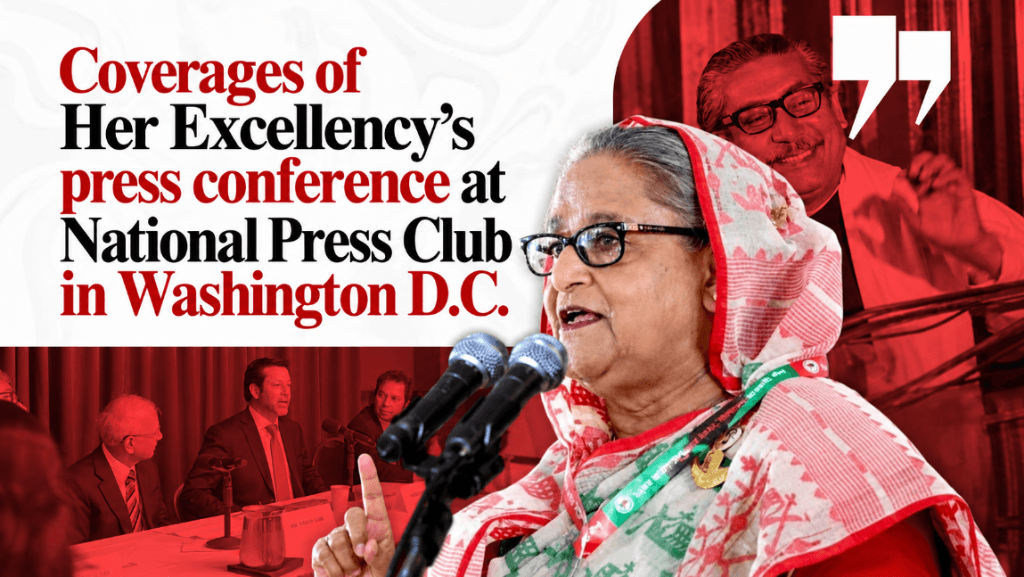
Coverages of Her Excellency’s press conference at National Press Club in Washington D.C.
Indian, Bangladeshi and international media coverage of Her Excellency Sheikh Hasina’s press conference at the National Press Club in Washington, D.C. — the full list of outlets, with a link to each report.
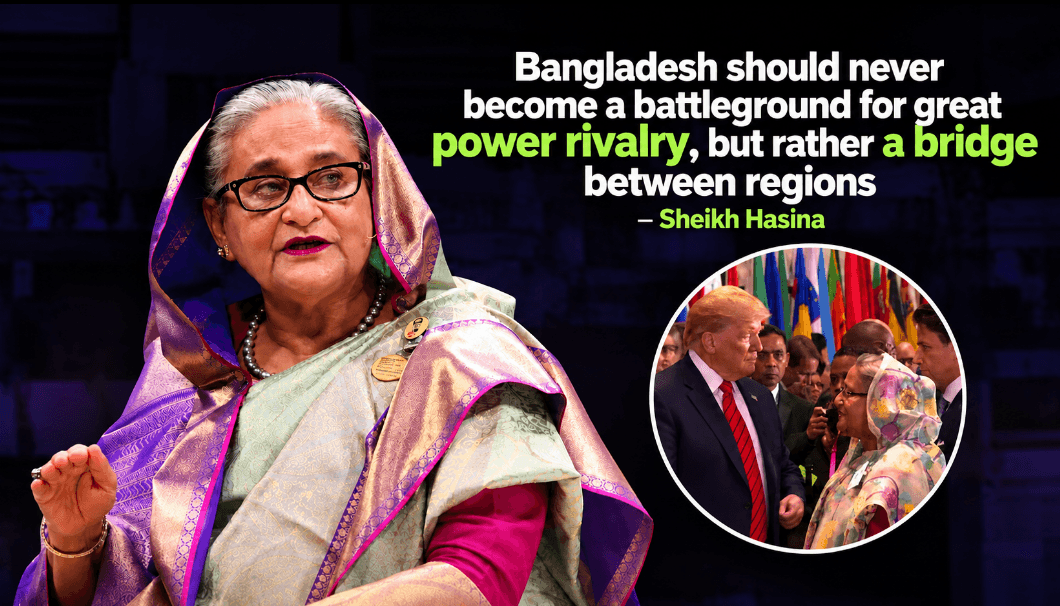
I Ask Washington to Choose Democracy
Speaking from Washington, D.C., Sheikh Hasina asks the United States not to pick a side in Bangladesh, but to stand for free elections, independent courts, due process and a future built on reconciliation, not revenge.
Sheikh Hasina’s interview with PTI: return to Bangladesh, India ties and the economy
In an interview with the Press Trust of India, Sheikh Hasina speaks on her return to Bangladesh, the death sentence, India–Bangladesh relations, Teesta, the economic downturn, the measles crisis and the 2024 protests.